

We've Lost Control—And That's Exactly What We Must Accept to Survive
By Laurent ledoux and Patrizia Cocca
"Threatened nature becomes threatening: our excessive control has caused us to lose control. We will now have to live in a fluctuating world, that is to say, invent the civilization of robustness [resilience], against performance."— Olivier Hamant, Director of the Institut Michel Serres
Hamant uses a powerful metaphor: Kintsugi, the Japanese art of repairing broken ceramics with gold. Rather than hiding cracks or restoring original perfection, Kintsugi embraces the breaks, making them beautiful and central to the object's identity. The bowl becomes more valuable precisely because of—not despite—its history of breaking.
This is what organizations must learn: to build from their imperfections, not mask them.
Our greatest organizational weakness, Olivier Hamant Hamant argues, is paradoxically our obsession with performance itself. We are biologically wired for it—our brains reward performance with dopamine, an evolutionary adaptation from times of scarcity. But in a world of abundance that we're depleting, being rewarded for performance has become catastrophic.
The solution isn't resilience understood as the ability to bounce back stronger. Hamant clearly distinguishes robustness from resilience: robustness maintains stability despite fluctuations and changing conditions, while resilience requires adaptation and transformation. It's not simply about bouncing back; it's about transforming. And transformation requires something counterintuitive: sub-optimality.
Hamant offers a striking example: human body temperature at 37°C. Every protein in our body has its own optimal temperature—some at 35°C, others at 44°C. At 37°C, all our proteins function well, but none function very well. They're deliberately sub-optimal. Why? Because when fever strikes, suddenly many proteins reach their optimum, surprising pathogens with unexpected efficiency. Sub-optimality creates adaptive capacity.
This principle echoes work we explored years ago at PhiloMa with the late Bernard Lietaer, a visionary economist ahead of his time. His research on monetary systems, inspired by the work of biologist Ulanowicz, revealed a fundamental trade-off: systems optimized solely for efficiency become brittle and prone to collapse, while systems that balance efficiency with resilience through diversity and interconnectivity remain sustainable. The optimal balance isn't at either extreme—it lies in rejecting the pursuit of maximum efficiency, or put differently, accepting a certain "inefficiency" to maintain adaptive capacity.
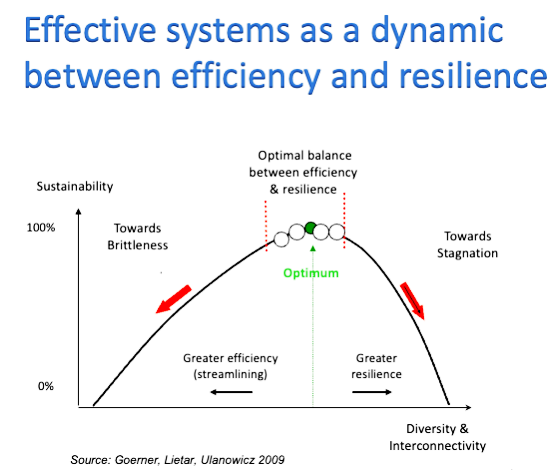
This insight has profound implications for managing our organizations, and even our societies.
Throughout my career—including restructuring at BNP Paribas Fortis, transforming Belgium's Ministry of Transports and Mobility, and now through my consulting work with EquisLeadership—I've witnessed this pattern repeatedly: organizations optimized for maximum performance become catastrophically fragile when conditions change.
We've thus eliminated redundancy for efficiency, centralized decisions for speed, removed diversity for coherence, and pursued maximum efficiency in resource allocation. In doing so, we've created organizations that function brilliantly in stable conditions but shatter under pressure.
Make no mistake: This is NOT a call to abandon excellence. It's the simple recognition that in complex, dynamic systems, sub-optimality at the local level can create greater adaptability at the global level. It's therefore about designing organizations capable of transformation, not just resistance.
Consequently, at EquisLeadership, we help organizations transition from hierarchical structures based on control to collaborative leadership structures. This means examining and often rethinking governance around three fundamental dimensions:
Human dimension, centered on personal accomplishment of collaborators—How people experience inclusion, autonomy, growth, pleasure, and meaning in their work.
Organizational dimension, centered on efficiency—How resources are best allocated to achieve the organization's objectives.
Societal dimension, centered on societal contribution—How the organization creates value for society at large, distributed equitably.
The collaborative governance that EquisLeadership proposes adopts the Kintsugi approach: it strengthens the organization's adaptive capacity by distributing leadership. In doing so, it embraces heterogeneity and more readily accepts local variations. This can sometimes induce divergences in decision-making, but it enables more thoughtful adaptation and greater capacity to absorb shock
This work involves simplifying governance structures by removing unnecessary hierarchical layers, establishing clear decision-making rules that enable autonomous action at levels closest to the ground, and creating conditions where information flows freely rather than through centralized control points.
In practice, this means:
→ Distributing leadership closer to where decisions need to be made (supports all three dimensions mentioned above: gives people autonomy and meaning, makes decisions more contextual and efficient, and distributes power more equitably)
→ Multiplying decision-making centers rather than centralizing them (human level: increases inclusion and psychological safety; organizational level: strengthens resilience; societal level: indirectly contributes to forming citizens more respectful of democratic values)
→ Valuing heterogeneity in perspectives and approaches over standardized procedures (human level: fosters inclusion and personal development; organizational level: helps improve problem-solving; societal level: indirectly contributes to forming citizens better able to live together in diversity)
→ Creating space for more deliberate processes when necessary (human level: enables greater engagement from everyone; organizational level: increases decision quality; societal level: fosters greater attention to the needs of all stakeholders)
→ Accepting local variations in how work is accomplished (human level: honors contextual autonomy; organizational level: enables adaptive efficiency; social level: indirectly contributes to employee engagement in local life)
The approach draws inspiration from collaborative governance models—sometimes called teal, liberated, or sociocratic organizations—which enables organizations to shift from centralized management focused on control to distributed leadership fostering adaptation.
More than ever perhaps, humanity's future and its capacity to survive what it has itself developed or engendered (AI, nuclear power, climate disruption, destruction of our ecosystems, ...) are uncertain. This is probably our only collective certainty. The question is therefore how we will adapt collectively to face these challenges and avoid destroying ourselves. What I've described above is the approach that EquisLeadership proposes to modestly help organizations adapt and indirectly contribute to profound societal change.
"The 21st century will be fluctuating. Organizations optimized for today will shatter; those designed to transform will thrive. The path? From centralized control to distributed leadership—from fragility to resilience." — Laurent Ledoux
What approach do you propose? Can you identify what you've considered until now as organizational weaknesses but which could in fact be essential sources of your organization's resilience?
